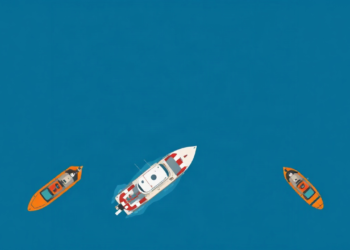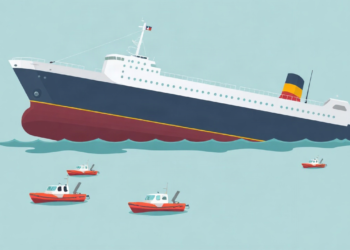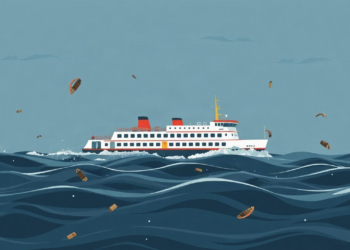
The search and rescue operations for the passenger ship “Filo Jet,” which sank 554 meters deep off Kyrenia, are considered one of the most challenging operations in maritime history. The Turkish Naval Forces are striving to reach the missing individuals with the help of teams equipped with advanced technologies. The deep-sea conditions, in particular, are complicating the search efforts.
The Southern Sea Area Command is participating in the operations with a team of approximately 800 personnel. Rear Admiral Baybars Küçükatay announced that a total of nine ships and eleven aircraft are actively operating in the area, including the main units of the operation, TCG Alemdar and TCG Işın. The operations continue 24/7 from the seabed to the surface shores.
The wreck’s location at a depth of 554 meters makes manned dives nearly impossible. Therefore, remotely operated underwater vehicles (ROVs) are emerging as the most significant supporters of the operation. These vehicles are controlled by cables extending hundreds of meters from the ship and can record objects they identify and assist with extraction operations using necessary equipment.
The ROV used in TCG Işın boasts impressive features. Able to dive to depths of 1000 meters, this vehicle has a capabilities to carry loads up to 135 kilograms. It is also reported to be equipped with thermal cameras, making a substantial contribution to the process of locating individuals lost in deep waters.
Challenges of the Search Operations
In deep-sea search efforts, simply locating the wreck is not enough. The wreck’s position, condition, and the precise identification of surrounding debris must be determined. Advanced technologies such as side-scan sonar and multi-beam echo sounders are employed for this purpose. These systems allow for the location of objects on the seabed to be identified.
To ensure the ROV operates safely, the position of the surface ship must also be maintained. This is where the dynamic positioning system aboard TCG Alemdar and TCG Işın comes into play, keeping the ship stable despite the effects of wind, waves, and currents. This system is critically important for the accurate and safe functioning of underwater vehicles.
Process of Reaching the Missing
Once missing persons are identified by the ROV, the second phase of the operation begins. This phase involves bringing the lost target to the surface. Detailed calculations must be carried out to recover a target from a depth of 554 meters. The weight of the underwater lifting line and currents acting upon the line are crucial in this phase.
Lieutenant General Eren Günay, Commander of Underwater Operations, stated that search and rescue operations are conducted under the control of the Southern Sea Area Command. He noted that the Turkish Naval Forces are among the few countries worldwide conducting search operations at such depths, asserting, “We are conducting search efforts day and night using all the resources and capabilities of our state for our citizens.”
Finally, it was reported that the number of deceased in the accident off Kyrenia has risen to 12. The names of missing individuals like Cansu Polat, Elmas Demir, and Şerife Özdemir have also been identified, while search and rescue operations for 16 others continue without interruption.
Source: www.diyaloggazetesi.com